
Words Unsaid
The Island of Dr. Death and Other Stories


Ekphrasis
Surf leaps from green seas beneath toppled grey skies and threaten the feet of the figure in black picking his way along the shore with his cane. You peer down from the high window of your turret bedroom, on the fourth floor of the big house at the end of the boardwalk.
You stash the book beneath the pillow and unlatch the door, then make your way down the half-spiral stair, careful to avoid the landing that always squeaks. Mama is resting in her room. You know not to wake her.
You hear kitchen sounds coming from below, and take the remaining stairs as quickly as you dare. Stopping at the kitchen door, you look in. But it is only Mama’s sister, who gives an annoyed look from behind a bag of groceries as you rebound out the open front door and into the drive.
Out onto the boardwalk and you can see the whole beach. But there is no man. No cane. Dejected, you seize a hock of driftwood and wander onto the sand. The tide is coming in. You draw your name at its edge before turning back to the house.
Gaining the boardwalk, you hear a rumble oncoming. Jason in his Jaguar returning from one of his trips into town. Maybe the drugstore. Like when he got you the book.
It is tucked safely now beneath your pillow. Dog-eared near the back. The cover is glossy and shows a man in red rags fighting a bloody man-ape. Behind them is Dr. Death.
“Greetings, Tackman Babcock.”
You wheel around. The man with the cane. He wears a long coat and his hair is slicked over a skull-like face.
“I saw you on the beach.”
“Did you now? Well. I am here to deliver a message. I understand you are preparing for a party and I intend to attend. But there is something you need to know —something which I feel it is my duty to prepare you for.”
You are still.
“That book beneath your pillow. You are nearing the end, aren’t you?”
You look down. “Yes.”
“Your mother, Tackie — she loves you, although she may not always say so. I know it can be difficult. But there comes a time when words can no longer be said.”
Bright face and dark cloak wash into sky and sea. Surf crashes in your ears. You rub your eyes and when you open them, he is gone.
“Who are you talking to, kid?” Jason straightens his jacket beside the open car door. He pads his pockets for something, and finds what he is looking for.
“No one!” You grab your stick and run into the house.
Exordium
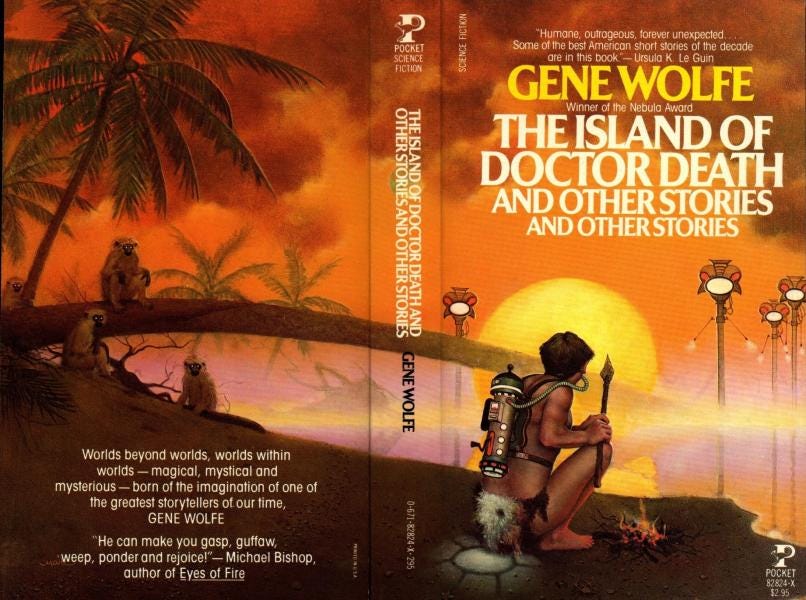
“The Island of Dr. Death and Other Stories” is a short story written in 1970 by Gene Wolfe. It has been on my desk but a few days and is already full of my ink. The above is my tribute to the story and to Wolfe himself, whose words seem to find me just how and when I need them to.
Wolfe changed the way I read. One result of which is that I greatly resist secondary interpretation of text — until I have formed my own. This is an attempt at that.
That it blossomed first into the above scene was quite the surprise to me. I knew I wanted to introduce you to something of the experience that the story gave me. And I knew that I would not be satisfied by a quote. To find Wolfe’s hand on my pen — I could not have expected that.
There are no spoilers in what I have shared with you because what happens in the story largely occurs off the page. That is characteristic of Wolfe. He writes questions, not answers. Seeking one, one finds the other.
But be warned. The longer you read what I am about to write, the less you will participate in the question on your own terms. I urge you as I urge myself, to read it for yourself. Trust yourself. Stumble on. And return to these thoughts when you will. I will be waiting.
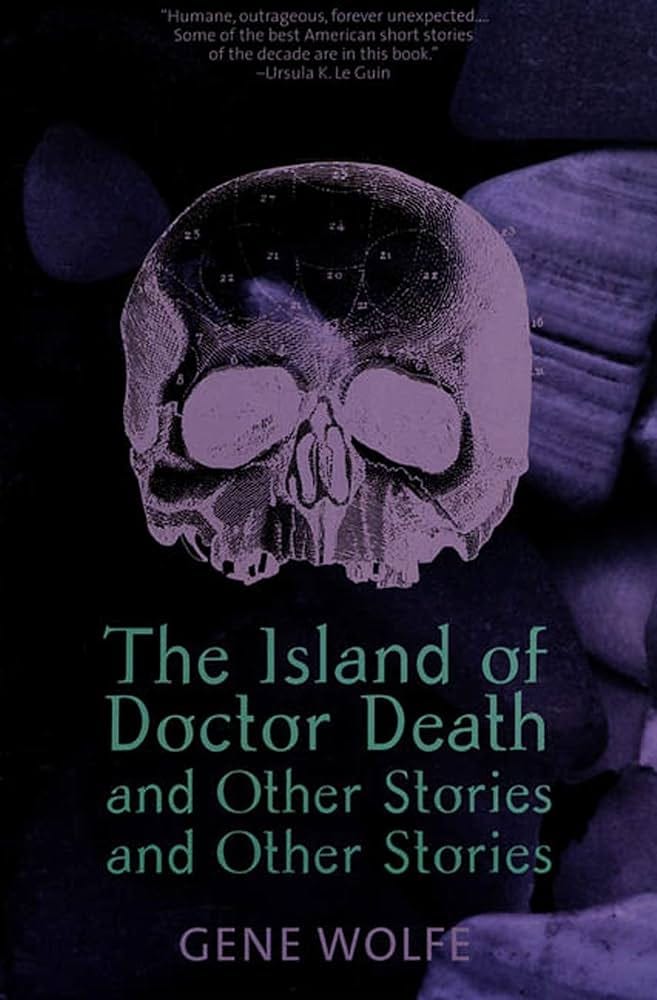
“The Island of Dr. Death and Other Stories and Other Stories”
Publisher: Tor
Used: AbeBooks / ThriftBooks
Borrow: Internet Archive / Library
ISBN: 067149516X
Aporia
Now you have returned, having had an experience — or an itching curiosity. But before I offer you my take - my synthesis - I would pose to you what questions the story posed in me.
In this I will adopt the voice of the storyteller.
What makes you taller?
When Captain Ransom disembarks the raft and greets you on the beach, you feel taller and older. Ransom thanks you for aiding him, and you tell him about you and Mother, and why she won’t enroll you in school. She wants for you what Father would have given you. You offer him a room in the house to stay.
Later at the restaurant, you meet Dr. Death. His face is pale and reminds you of a bust from Papa’s library. Unlike Captain Ransom, Dr. Death makes you feel no older.
At the party, you hide under the table. When Captain Ransom beckons you forth, you feel very small. Standing, you feel older.
Who is Mother? Who is Mama?
Dr. Black visits the day before the party, along with Aunt May and Aunt Julie. Aunt May is Mother’s older sister. Aunt Julie is Papa’s sister, and you know she wants Mama to marry again so Papa won’t have to send her money anymore.
When you meet Dr. Death at the restaurant, and his face reminds you of the bust from Papa’s library, you remember living there with Mother. Then you remember Mama saying how good-looking he was.
Who are you?
This is your story. It is about the last days you spent in the big house Mama calls The House of 31 February before something happened.
Your story is addressed to you. You speak to yourself of yourself. Never as he. Never as I. Always as you.

Anagnorisis
We all have within us the boy unwelcomed. The home that is not home. The wish unspoken and ever awaiting awakening.
We also have within us a story. A story of what happened to us. A story of who that happening made us.
We carry that story with us. Like a worn paperback in the back pocket.
The story tells us who we are. Reminds of our limits. Our smallness. And no matter how deep we bury it, it enters our lives over and over again until…
The story changes. We pick up the pen and accept that the telling of our story is ours. Imperfect, imagined, and faulted. But ours.
It is the choice we can make. To accept our own authorship. To know that the story will end. And to befriend that story, that we may befriend its end.
But we need not start there. Writing our story has a beginning, too. And in the beginning — when we were new, when the world was young — something happened.
I know this is so and yet that happening is so difficult to name within myself.
There was a move across the country. Foray into friendless land with strange words and stranger people. Glaring merciless summers. Safe retreat into inner worlds.
Something that was already stirring within took hold in those years. It looked like science fiction. It looked like video games. It felt like fading.
Yearning to be seen, oh yes. I knew how to put on a show. It was safer than being real and not unrewarding. I showed up. I took the stage. But secretly, I wasn’t there at all.
That story of retreat wrote my life for the next twenty years. And life today is something akin to an allergic reaction to it. I have become the anti-retreat. The always-seen. I wear myself out so that I may never see myself as shrinking.
In short, I am telling a new story. These words are proof of it.
Yet reflecting, I’m sure there are other stories worth turning back the page on. The worlds of my first and second adulthoods are painfully invisible to each other. Their only reconciliation resides within my heart and my will. And that is a heavy one to hold.
There is also the story of the performer. The more he aches for connection, the less he experiences it. To arrive as oneself is an odd trick. There is a somewhere between me and who I think I am — a rocky climb I have backslid on more than I care to admit.
You too have a story to tell. Perhaps a story of what happened to you that you tell yourself over and over again. And each time, you get a little closer to something — something that hurts. Something that, shoulder-to-shoulder with a little help, you might be tall enough to meet.